The Boundary Weed: Assessing Japanese Knotweed Risk Before Exchange
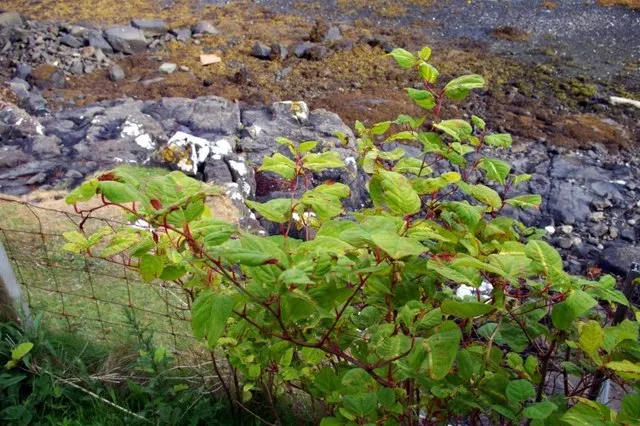
Photo: James Yardley, CC BY-SA 2.0, via Wikimedia Commons
Japanese knotweed occupies an unusual place in the British property mind. It is a plant, not a structural defect, yet it can influence a mortgage offer, a negotiation and a buyer's confidence within days. The difficulty is that the subject attracts both overstatement and complacency. A surveyor's job is not to promise that a property is free of knotweed; it is to report what can be seen, identify where further investigation is prudent, and help a buyer ask better questions before exchange.
What a visual survey can establish
A surveyor inspecting a house is looking for evidence: distinctive shield-shaped leaves, hollow stems with a zigzag growth pattern, reddish shoots in spring, or dense stands in late summer. Mature stands are often obvious. Smaller growth, recently cut stems, or plants tucked behind a shed or boundary fence are less so.
A standard building survey or homebuyer report is a visual, non-invasive inspection. It does not involve excavating soil or tracing rhizome underground. That limitation matters because Japanese knotweed spreads principally through its rhizome, which can remain dormant and can extend beyond the visible plant. A survey can record a suspected stand, note its proximity to the building and recommend specialist advice. It cannot confirm that the rhizome has been eradicated, nor can it prove absence simply because no growth was visible on the day.
Season also affects what is seen. In winter, growth dies back and the plant is far harder to identify. A survey carried out in January is not worthless, but the visible evidence may be much thinner than in July. Buyers should read a survey's knotweed comments as a prompt for evidence, not as a definitive clearance.
Why lenders and householders view the same plant differently
Mortgage lenders tend to treat Japanese knotweed as a question of security and resale. Their concern is understandable: if a property is affected, some future buyers may be deterred, and remediation can be costly. Lending policy, however, is not uniform. Some lenders will proceed where a professional management plan and an insurance-backed guarantee are in place. Others may require a retention, a specialist report, or evidence that the plant is sufficiently distant from the building. In 2026, the practical position still varies from lender to lender and valuer to valuer.
For a householder, the question is more grounded. How close is the visible growth to the house? Is it a mature stand or a few stems? Has it been treated, and with what result? Is the ground between the plant and the building hard standing, a driveway, a lawn or a flower bed? Common guidance refers to a seven-metre radius as a rule of thumb, but it is not a statutory rule and it should not be used as a substitute for site-specific advice. Distance matters, but so do the age of the infestation, the direction of spread and the history of management.
The gap between lender caution and practical risk is where most knotweed decisions are made. A lender may be cautious about a small stand next door even where a specialist considers the immediate risk to the house to be low. Equally, a lender may accept a treated stand on the property where a proper plan and guarantee exist. Buyers need both views: the lender's requirements in writing and a specialist's assessment of the physical risk.
When the knotweed is next door
A neighbouring infestation raises a different set of issues. The first task is to establish exactly where the growth sits in relation to the boundary and the house. A stand on the far side of a neighbour's garden is not the same as growth pressing against a shared fence. The second task is to find out whether it has been investigated or treated. Neighbours are not obliged to provide a management plan, but sellers often know more than they first disclose, and solicitors can ask specific questions of the seller.
A surveyor may be able to see growth from the property, but access to the neighbouring land is often limited. That is one reason recommendations for further investigation are common. If the plant is close to the boundary, a specialist can assess the likely extent of the rhizome and advise on monitoring. It is also worth asking whether any community protection notice or other local authority action has been taken in respect of the plant, though such measures are not a substitute for private due diligence.
Questions to put before exchange
Before exchange, buyers should move from general concern to specific evidence. Useful questions include:
- Has Japanese knotweed ever been identified on the property or on adjoining land?
- If so, when was it identified and what treatment has been carried out?
- Is there a management plan, and is it being followed?
- Is there an insurance-backed guarantee, and can it be transferred to a new owner?
- Has a specialist survey been undertaken, and can the report be seen?
- Are there any known disputes, notices or neighbour discussions about the plant?
- What is the lender's position, confirmed in writing?
- What would remediation or monitoring cost, and over what period?
Indemnity policies are sometimes mentioned in knotweed transactions, but they are not a cure-all. A policy may be unavailable or limited where the problem is already known. Buyers should read the terms rather than assume that an indemnity policy provides practical remediation.
If knotweed is found on site or next door
The first step is not to arrange excavation. Disturbing rhizome can spread the problem and complicate treatment. A specialist contractor accredited by the Property Care Association or a member of the Invasive Non-Native Specialists Association can provide a site-specific assessment and a management plan. Treatment commonly involves herbicide applied over one or more growing seasons, sometimes followed by excavation where construction or landscaping is planned. An insurance-backed guarantee is often the document lenders and future buyers want to see.
Inform your solicitor and lender promptly. If the property is affected, the lender may require the management plan before it will release funds. If the plant is next door, ask the specialist to set out the likely risk to the house and the basis for that view. Negotiation may take the form of a price adjustment, a retention, or a requirement that a treatment plan be in place before completion. Each route has consequences, and the right one depends on the evidence rather than on the headline.
A proportionate conclusion
Japanese knotweed deserves attention, but not panic. A survey that notes its presence, or its possibility, is doing its job by prompting the right investigation. The buyer's task is to replace rumour with records: a specialist report, a management plan, a guarantee, and a lender's written position. Where those documents are clear, a purchase can often proceed on a sensible footing. Where they are missing, the uncertainty itself is the risk. At Herring Surveyors, we would rather a buyer exchange with a documented view of the boundary than with a vague reassurance that the plant is probably nothing to worry about.