Brick, Beam and Birthday: Using a Home’s Era to Ask Better Survey Questions
A house is not simply old or new. It is a record of the materials, building practices and regulatory standards of its time, altered by decades of occupation, repair and neglect. For a buyer in 2026, the age of a property can be genuinely useful: it can tell you which parts of the building deserve closer attention and which questions are worth putting to a surveyor before you commit. What it cannot do is tell you whether a particular wall is sound, a roof is watertight or a timber is infected. Age is context. The survey is the evidence.
Why the build date matters — but only up to a point
Most residential buildings in the UK fall into recognisable periods, and each period carries its own familiar survey themes. A Victorian terrace, a 1930s semi, a post-war estate house and a 1960s or 1970s home were not built in the same way, and they have not aged in the same way either. Knowing the likely construction can help you read a survey report with more confidence and ask more focused follow-up questions.
The caution is straightforward. Two houses built in the same year can be in entirely different condition. One may have been re-roofed, re-wired and damp-proofed; the other may still have its original rainwater goods, blocked airbricks and a rear extension of doubtful provenance. A house’s era may narrow the list of likely issues, but it cannot rank them. Only an inspection of the actual property, together with whatever documentary evidence is available, can do that.
Victorian and Edwardian terraces: solid walls, shallow footings and later alterations
Older terraces are often built with solid brick walls, relatively shallow foundations and timber floors. That combination is not a defect in itself. Many such houses have stood for well over a century and will stand for many more. But the construction does shape the questions a surveyor will ask.
Solid walls behave differently from cavity walls. They rely on the right balance of moisture and ventilation, and they are less forgiving of raised external ground levels, cement-rich renders and sealed internal surfaces that trap moisture. A buyer should expect the survey to comment on damp-proof courses, sub-floor ventilation, lintels over openings and the condition of any bay or rear addition. Timbers embedded in masonry, such as joist ends and wall plates, are another natural focus.
Shallow footings matter where trees, drains or heavy extensions are close by. Movement in an older terrace is not automatically a crisis, but it does need to be understood in context. The surveyor will want to distinguish longstanding settlement from recent cracking, and to consider whether drainage, vegetation or alterations are involved.
1930s semis: early cavities, bay windows and roof geometry
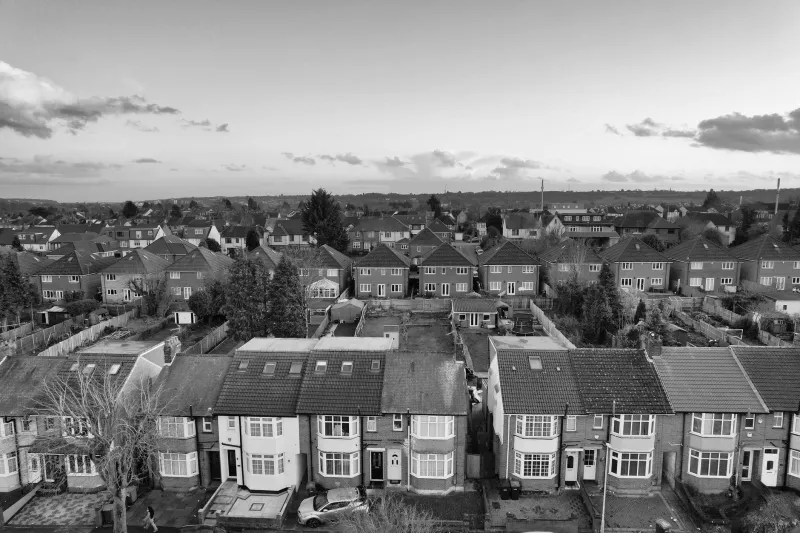
The inter-war semi is one of the most familiar house types in Britain, and its survey profile is equally familiar. Many were built with early cavity walls, often narrower than modern cavities, and with bay windows, hipped roofs and decorative render or tile-hanging. These features are part of the property’s character, but they also create predictable points of wear.
Cavity ties in older walls may be of a type that corrodes over time, and wall-tie failure can show itself through horizontal cracking or bulging. Bay windows, particularly those with timber frames and small roofs, are exposed to weather on several faces and often need close inspection. Roof coverings may have been replaced, patched or coated, and the surveyor will want to judge the roof as it is today rather than assume it is original.
The 1930s semi is also a house that has frequently been extended. A rear addition, a loft conversion or a garage conversion can be perfectly sound, but the junction between old and new is where problems often concentrate. Drainage, ventilation and structural continuity at those junctions deserve specific questions.
Post-war estates: prefabrication, concrete and hidden materials
Homes built in the years after the Second World War include a wide range of construction methods. Some are traditional brick and block; others used prefabricated components, concrete panels or system-build techniques. The survey approach should reflect that variety rather than treating “post-war” as a single category.
Concrete elements can be durable, but they can also suffer from carbonation, reinforcement corrosion or poor original detailing. Where a property is of non-traditional construction, the surveyor may recommend further investigation by a specialist, particularly if a mortgage lender is involved. That is not necessarily a sign of a bad house; it is a sign that the construction method needs to be understood on its own terms.
Asbestos is another consideration in properties built or altered before the turn of the century. It may be present in ceiling tiles, insulation, cement sheets or floor coverings. A standard building survey is not an asbestos survey, and a buyer should not expect it to be. The sensible question is whether any suspected asbestos-containing materials are in good condition, likely to be disturbed, or already the subject of an assessment.
1960s and 1970s homes: flat roofs, timber frames and thermal upgrades
The 1960s and 1970s produced a great deal of experimental and pragmatic housing. Flat roofs, timber-frame construction, concrete cladding and large areas of glazing all became more common. Each brings its own survey questions.
Flat roofs need careful attention to drainage, coverings, parapets and outlets. A flat roof that performs well is not a problem; a flat roof that has been repeatedly patched may be nearing the end of its useful life. Timber-frame houses require an understanding of the frame, the cladding and the vapour control layer, especially where later insulation or external cladding has changed how the wall behaves. Cavity wall insulation installed decades ago may also be worth reviewing if there are signs of damp or cold bridging.
This period is also associated with asbestos in certain materials and with early forms of modern heating and electrical systems that may now be outdated. A surveyor will not test every service, but will comment on visible signs and recommend further checks where appropriate.
What era cannot tell you
A build date cannot tell you whether a roof has been replaced, whether a wall has been tied, whether a damp-proof course is working, or whether an extension was built to a reasonable standard. It cannot tell you whether a house has been well maintained or simply well decorated. Those are matters for inspection and, where necessary, for specialist advice.
Nor should era be used to dismiss a property. A Victorian house is not automatically problematic, and a 1970s house is not automatically inferior. The point is to let the age of the building sharpen your questions. Ask what is typical for the period, then ask what has actually been done to this particular house. The answer to the second question is the one that matters.
Using era as a prompt, not a verdict
Before you exchange contracts, use the property’s age to build a short list of sensible questions for your surveyor. Ask about the construction method, the roof, the walls, the drainage and any alterations that appear to have been made. Ask whether the surveyor saw anything that warrants a specialist report. Then read the answers in full, rather than treating the oldest or most alarming phrase as a verdict.
A good survey does not begin with a date. It begins with the building in front of it. The date simply helps you understand what you are looking at — and what you should be careful not to assume.